Deep Dive
Wed 17 December 2025 |
Africa's 2025 Maritime Threats in Review |
- Maritime insecurity offshore Africa increased in 2025, with a multitude of threat actors demonstrating the capability and intent to stage attacks against commercial vessels within coastal and deep-water areas.
- In the Gulf of Guinea (GoG), piracy attacks are on the rise again. Nigeria’s riverine criminal groups remained the predominant driver of nearshore and creek attacks, while organised pirate networks demonstrated the capability to conduct offshore boardings and kidnappings up to 100NM from shore.
- Similarly, piracy off Somalia and in the wider western Indian Ocean resurged, re-emerging following a series of nearshore hijackings of fishing dhows and a late-year pattern of long-range attempted boardings enabled by motherships.
- In the Gulf of Aden and Red Sea, 2025 maritime insecurity stemmed from limited but persistent Somali skiff activity near the western approaches of the Gulf of Aden and a continued, though reduced, pattern of hybrid conflict-related threats originating from Yemen-based Houthi rebels, with vessels encountering projectiles, Water-borne Improvised Explosive Devices (WBIED), and drones.
- Lastly, in Mozambique, Islamic State Mozambique (ISM) maintained the ability to conduct maritime attacks within internal and territorial waters offshore Cabo Delgado Province. However, most notably, this year recorded the first targeting of a foreign-flagged vessel to date.
|
Gulf of Guinea
Maritime insecurity across the GoG in 2025 reflected a combination of persistent nearshore criminality and continued offshore piracy activity, with incident clusters spanning internal waterways, territorial seas and deep-water EEZ zones.
Nearshore, insecurity was primarily concentrated along Nigeria’s internal waterways, where Niger Delta-based riverine criminal groups (RCGs), distinct from but closely overlapping with regional pirate networks, mounted at least 11 attacks (see sample Alert). Operating in creeks and channels across Rivers, Bayelsa, Akwa Ibom and Cross River states, these groups used high-powered speedboats to rob or abduct passengers from small commercial and commuter vessels, sustaining a local kidnap-for-ransom economy. Their activity levels were comparable to 2024 and indicate retained capability, resources and freedom of movement in riverine areas.
Outside Nigeria’s creeks, 2025 saw continued low-level robberies and attempted boardings at anchorages and ports across Angola, the Ivory Coast, Ghana, Liberia, the Republic of the Congo, and Nigeria (see sample Alert). These incidents typically involved small groups in wooden fishing boats or skiffs approaching anchored tankers, Offshore Support Vessels (OSVs), barges and containerships in internal or territorial seas to steal cargo.
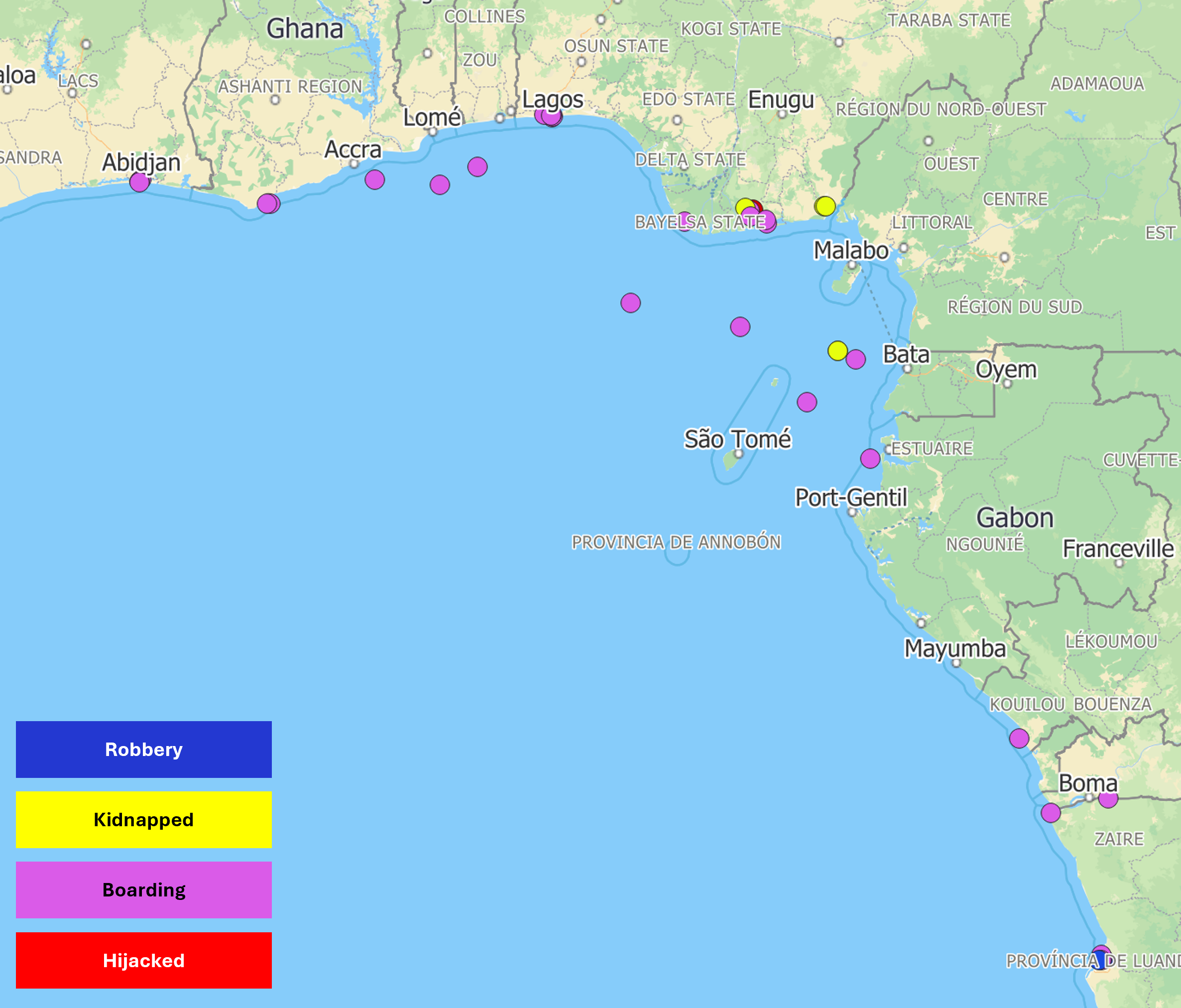
Offshore, piracy incidents occurred across both the contiguous zone (12–24NM) and the Exclusive Economic Zone (out to 200NM), with kidnappings and short-duration hijackings reported at progressively greater distances from shore. Near-shore incidents included the kidnapping of three Senegalese fishermen 15NM off Ngombé Point in Gabon and the abduction of three crew members 20NM southeast of Accra, Ghana. Long-range boardings were also recorded further offshore, including the kidnapping of one crew member 75NM north-west of São Tomé, and two boardings and one kidnapping within 40–75NM of Bata in Equatorial Guinea’s EEZ. The furthest incident from shore in 2025 involved the boarding and robbery of a merchant vessel 104NM southwest of Brass, Nigeria. In the most recent piracy incident in the GoG, on 03 December, a Portuguese-flagged tanker was boarded approximately 50NM southwest of Bata. Nine crew members were abducted, and one was injured before the attackers withdrew. The remaining crew navigated the vessel to Libreville, Gabon (see Alert).
The geographic distribution of these incidents in 2025 indicates that the GoG threat environment will remain elevated in 2026, with exposure varying by country. São Tomé and Príncipe and Equatorial Guinea recorded only far-offshore incidents, indicating continued risk of long-range boardings and kidnappings in the contiguous zone and EEZ. Liberia, the Ivory Coast, Angola, and the Republic of the Congo recorded only anchorage or port-proximate intrusions, indicating continued exposure to opportunistic theft in territorial seas. Ghana, Benin, Nigeria and Gabon experienced both nearshore and offshore activity, indicating a wider range of possible incident types, dependent on patrol presence and enforcement capability. However, risk profiles remain fluid; the use of high-speed vessels and any renewed adoption of motherships would allow pirate groups to reposition rapidly and expand their operating footprint with little warning, making mitigation measures essential for vessels operating in the GoG.
|
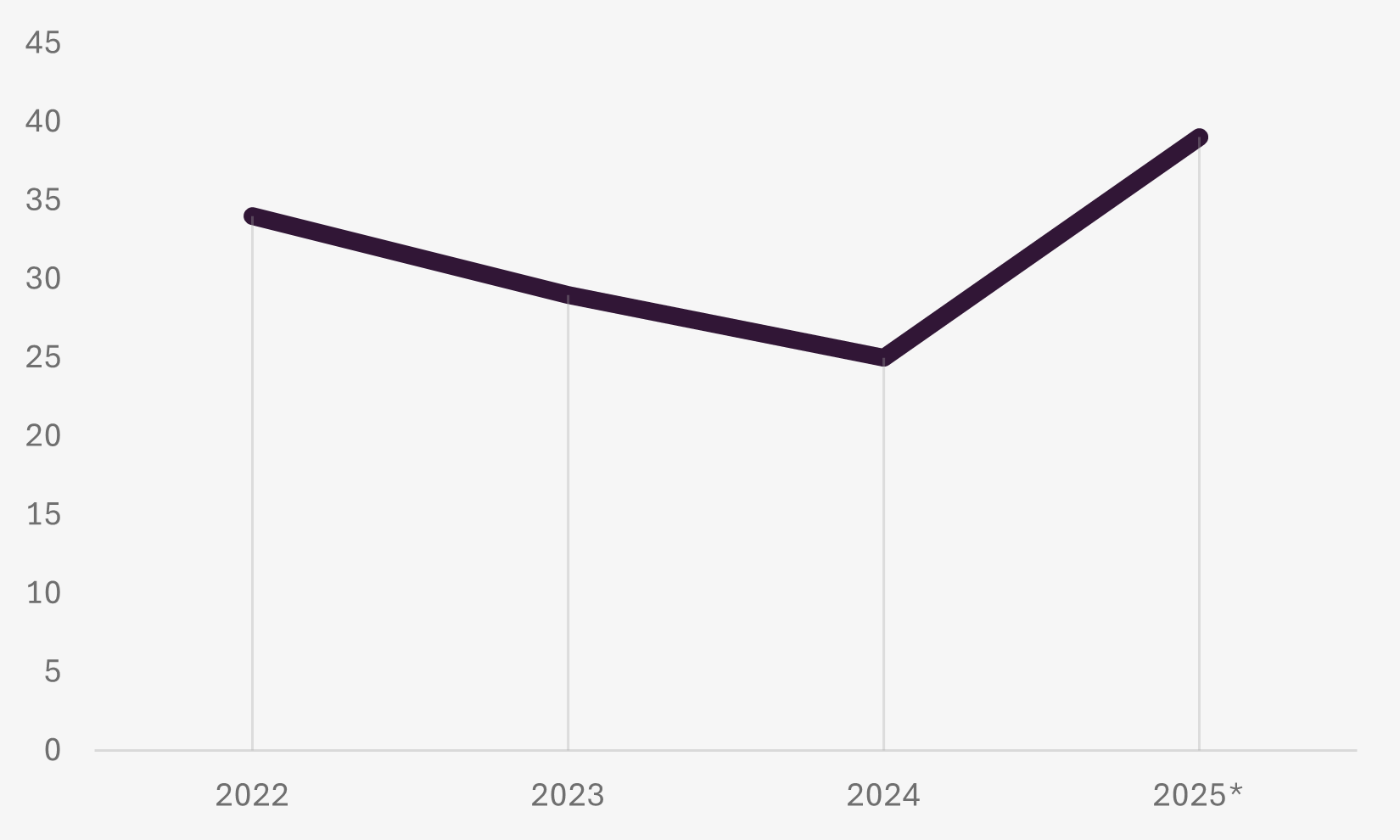
Boardings, fired upon incidents, hijackings, kidnappings and robberies in the area below (see map) between 01 Jan 2022 and 15 Dec 2025*. Source: Maritrace |
Map of major maritime security incidents in the GoG between 01 Jan 2025 and 15 Dec 2025. Source: Maritrace |
Somalia
Maritime insecurity off Somalia in 2025 was shaped by sustained nearshore attacks and a marked rise in long-range piracy attempts later in the year.
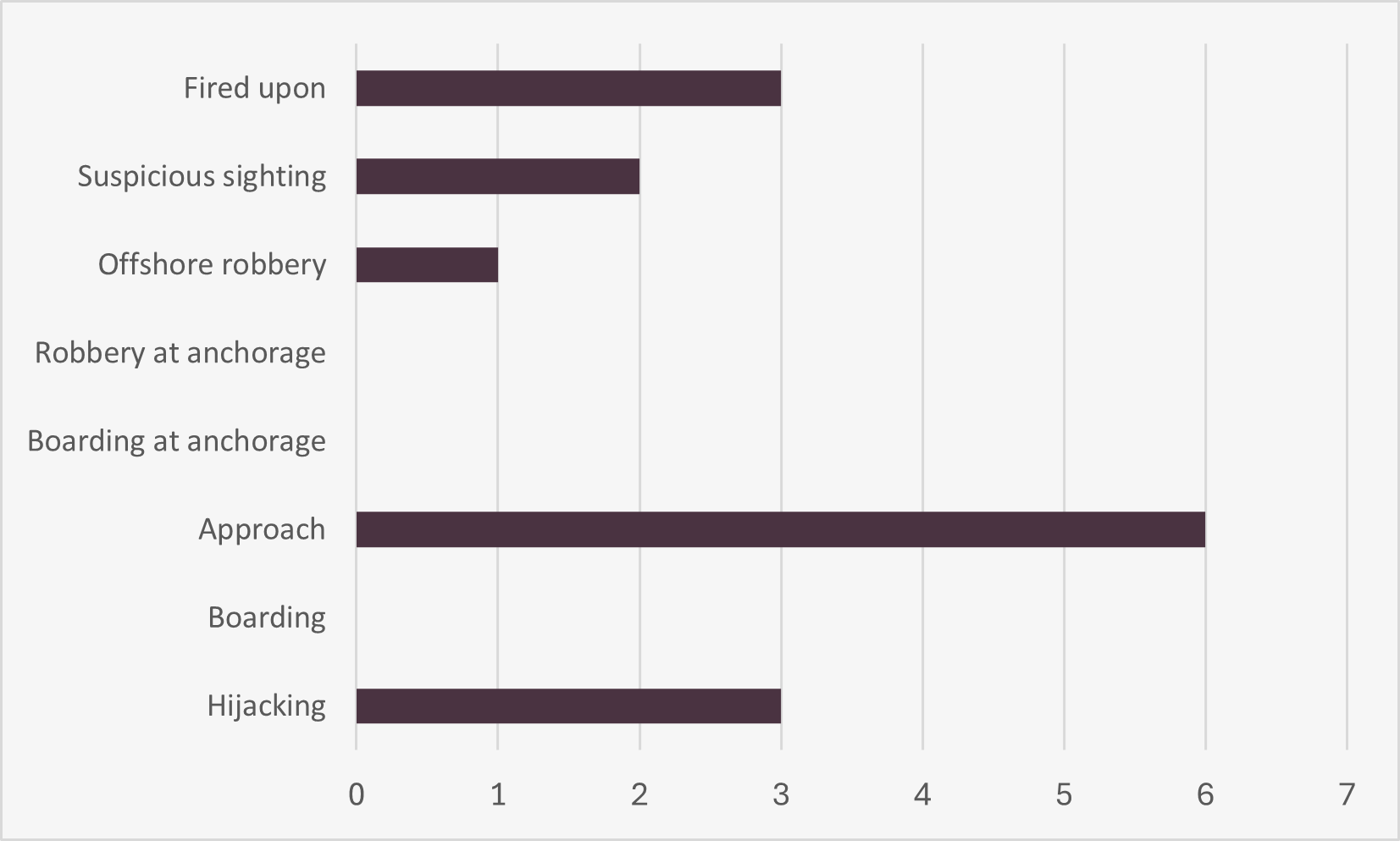
Nearshore, three hijackings, one armed robbery, and a gunfire incident were recorded between 3 and 24NM from the coastline, primarily targeting Yemeni and Iranian fishing dhows between February and April. Reports indicate that several of the hijacked dhows were intended for use as mobile platforms to support extended operations, although none were used in subsequent confirmed attacks. The most recent territorial-water hijacking occurred on 01 December, involving a Chinese tuna longliner 6NM offshore Eyl District, with a second incident recorded 20NM offshore on 06 December, where a dhow was attacked by armed pirates in a skiff. The pirates reportedly opened fire with automatic weapons, but the dhow continued its course, and no injuries were reported (see Alert).
In deep water, at least seven suspected hijacking attempts were recorded between 350 and 700NM from the Somali coast from October onwards. Three incidents involved the dhow ISSA MOHAMAD, hijacked in 2023 and used as a mothership. Skiffs deployed from the dhow attempted to board vessels, including the chemical tanker STOLT SAGALAND on 03 November (see Alert) and the Aframax tanker HELLAS APHRODITE on 06 November (see Alert), firing small arms and RPGs during the latter attempt. No robbery, kidnapping or hijacking occurred in deep waters.
The threat environment off Somalia is expected to remain substantial to severe in 2026, supported by demonstrated nearshore and renewed offshore reach, mothership use, willingness to fire on commercial vessels and variable naval coverage across the western Indian Ocean. While total incident numbers remain below historical peaks, the combination of nearshore and deep-water activity indicates persistent operational capability.
|
Type of incidents offshore Somalia in 2025. Source: Maritrace |
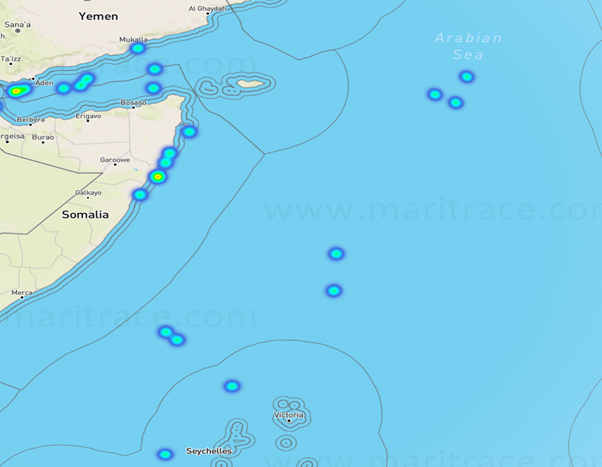
Heatmap of 2025 maritime security incidents offshore Somalia. Source: Maritrace |
Gulf of Aden and Red Sea Maritime security in the Gulf of Aden and the Red Sea in 2025 reflected two parallel threat streams: Somali piracy-related activity extending into the western approaches of the Gulf of Aden, and conflict-related hazards linked to Yemen’s Houthi-controlled coastline.
On the Somali side of the Gulf of Aden, piracy activity was limited. One suspicious approach was reported in April, when a merchant vessel observed four skiffs manoeuvring within one to two nautical miles while transiting inside the Somali EEZ. No weapons were observed, and no boarding attempt occurred.
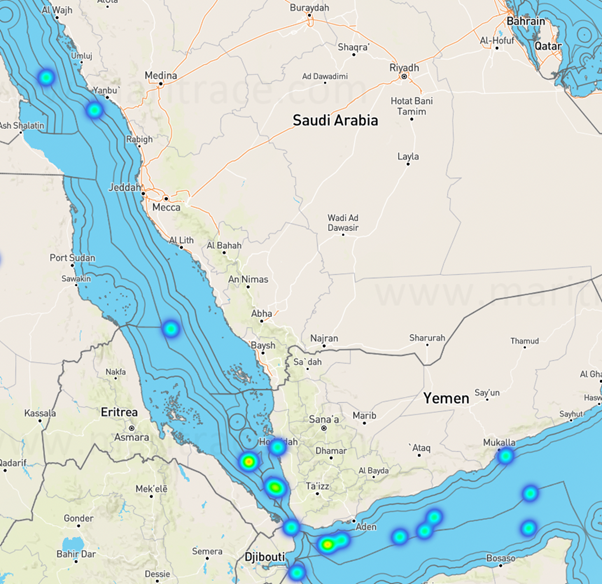
On the Yemeni side of the Gulf of Aden and into the Red Sea, missile and direct-fire incidents decreased relative to 2024. Eight direct fire incidents were recorded in the Gulf of Aden and Red Sea. Most notably, in July 2025, two commercial vessels were sunk in the Red Sea after being attacked by Houthi rebels, doubling the number of vessels the group had sunk during conflict since 2023 as well as the number of casualties (see Maritime Deep Dive). Over the course of the rest of 2025, vessels continued to encounter hybrid threats, including fast-skiff approaches, a confirmed WBIED 39NM offshore, unmanned surface crafts, and (Unmanned Aerial Vehicle) UAV swarms during direct and indirect attacks. The most recent incident in December 2025 involved approximately 15 small craft and direct fire (see Alert).
The threat environment in 2026 is expected to remain substantial to severe, with Somali PAG probing behaviour likely to continue in waters adjacent to the IRTC and Houthi forces retaining the capability to deploy WBIEDs, UAVs and small-boat harassment into the Red Sea during periods of escalation.
|
Heatmap of 2025 maritime security incidents in Gulf of Aden and the Red Sea. Source: Maritrace |
Mozambican Channel
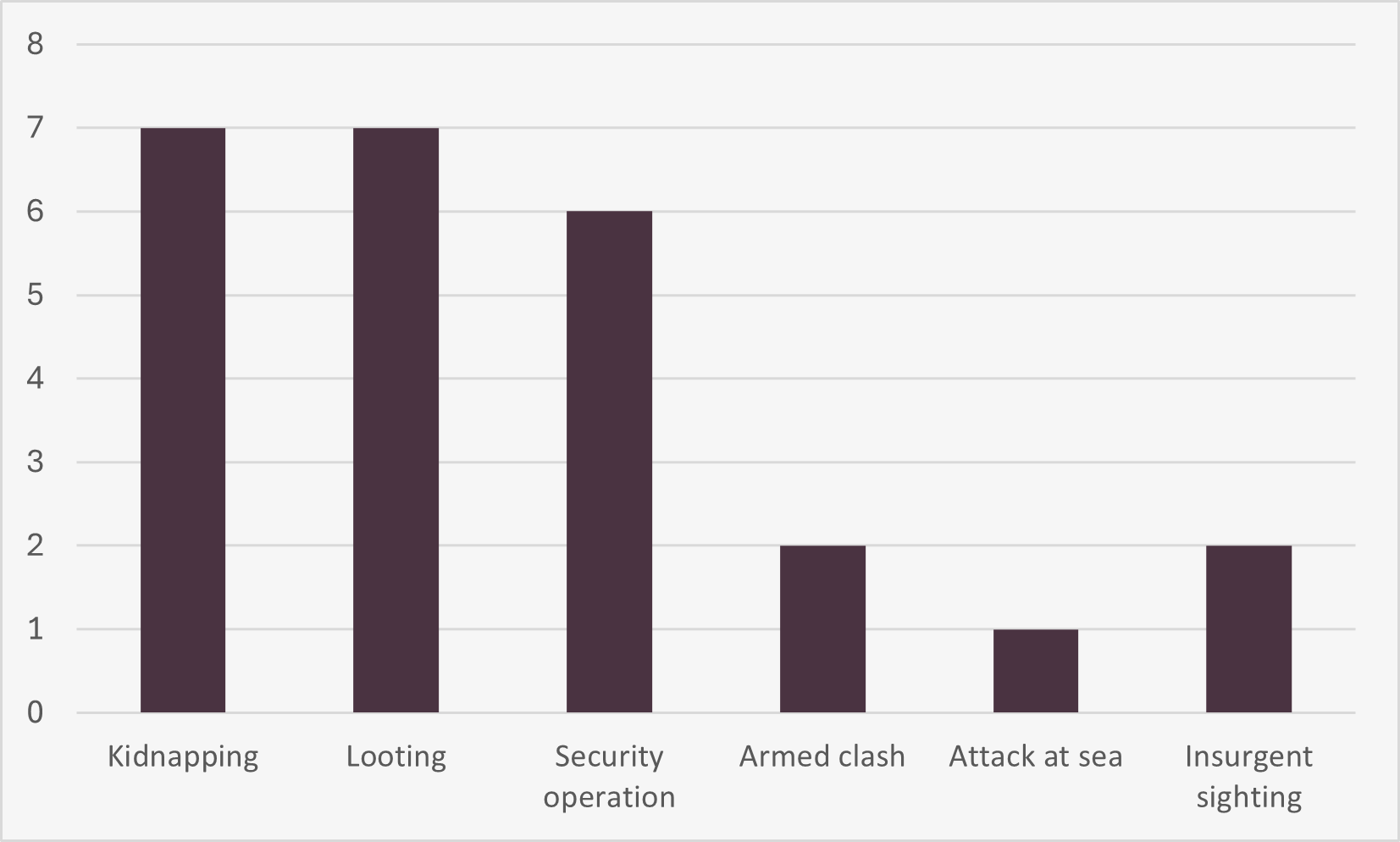
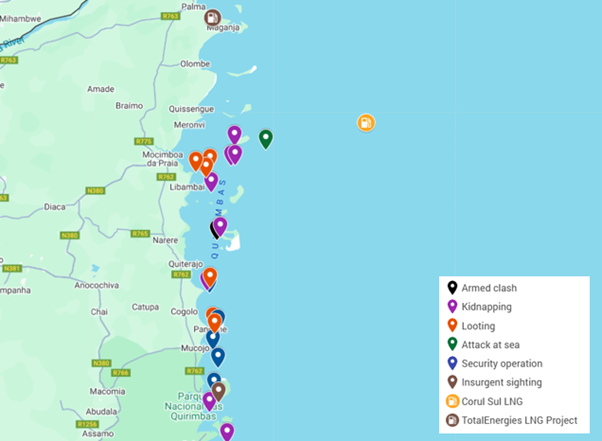
Maritime insecurity offshore Mozambique in 2025 emerged as a growing threat, driven primarily by ISM activity concentrated across the Quirimbas archipelago and the coastal corridor from Ibo to Palma District, Cabo Delgado Province. Militants abducted fishermen, looted boats and extorted coastal communities, with at least 12 maritime incidents recorded between January and November in Macomia and Mocímboa da Praia districts. Several incidents involved armed contact with Mozambican naval patrols, while security forces conducted multiple lethal operations at sea, resulting in approximately 30–35 fatalities among fishermen and suspected insurgent collaborators.
However, in the most significant offshore incident to date, ISM fighters opened fire on the research vessel Atlantida K-1704 approximately 4NM east of Tambuzi Island, demonstrating intent and capability to target identifiable foreign vessels (see Maritime Deep Dive). This was the first recorded attack against a commercial vessel in this conflict.
Maritime insecurity in 2026 is expected to remain substantial, with ISM likely to continue low-level looting, abductions and clashes with naval patrols within internal and territorial waters. Limited but possible opportunistic approaches further offshore cannot be ruled out, particularly as LNG-related vessel movements increase following October’s lifting of force majeure on TotalEnergies LNG Project in Palma District
|
Type of incidents offshore Mozambique in 2025. Source: Castor Vali and ACLED |
Map of 2025 maritime security incidents offshore Cabo Delgado, Mozambique. Source: ACLED, Castor Vali |
Africa’s maritime outlook for 2026 points to a persistently high-risk environment, with piracy, criminality, and conflict-related threats showing little sign of abating. In the Gulf of Guinea, riverine gangs and offshore pirate networks are expected to continue targeting commercial vessels, with long-range boardings and kidnappings remaining a significant danger. Somali waters are likely to see a resurgence in both nearshore and deep-water attacks, aided by hijacked dhows used as motherships and gaps in naval coverage. Meanwhile, the Gulf of Aden and Red Sea face ongoing hybrid threats from Houthi forces, including drones, explosives, and fast-boat harassment. Off Mozambique, Islamic State activity threatens to challenge coastal security, with abductions, looting, and confrontations with naval forces likely to persist, alongside a growing risk to foreign-flagged vessels as LNG operations expand. Across the continent, maritime insecurity is expected to remain fluid and unpredictable, underlining the urgent need for vigilance, robust risk management, and stronger regional cooperation. For businesses and mariners, 2026 will demand heightened awareness and preparedness to navigate Africa’s increasingly contested waters. |
Disclaimer
You have received this report as part of your organisation’s subscription. Castor Vali assessment and advice is given based on the information received and processed by us and the surrounding circumstances known to us to exist at the time. Subsequent changes to relevant information or the surrounding circumstances may affect the reliability of our assessment and advice, but we do not accept responsibility for that effect. We do not accept responsibility for the outcome of any action taken or not taken as a result of our assessment and advice unless the possibility of that action being taken or not taken is set out in specific terms in our instructions. |
UK Global Head Office: Castor Vali Ltd
Davidson House, Forbury Square, Reading, RG1 3EU, United Kingdom
West Africa Regional Headquarters: Castor Vali Nigeria
No 56a Akintude Adeyemi Drive, Off Chief
Collins Street, Lekki Phase 1, Lagos, Nigeria
East Africa Regional Headquarters: Castor Vali Africa (Kenya)
Unit B, Northern Wing, 2nd Floor, Nairobi Business Park, Ngong Road,
Nairobi, Kenya. PO Box +254 711 105 879 – 00505
United Kingdom | Nigeria | Ghana | Somalia | Kenya | Tanzania | Zanzibar |
Mozambique | South Africa | Mauritius | Dubai
Operations Centre (24 Hrs): +254 (0) 20 440 9614 | +254 (0) 711 105 879
info@castorvali.com |
|