Weekly Report
Thursday 08 January 2026 |
Weeks of Wednesday 17 December 2025 to Tuesday 06 January 2026 |
Dear Client, Please find below our most recent Kenya Weekly Report. If you have any queries about our reports, please contact us at africaops@castorvali.com. |
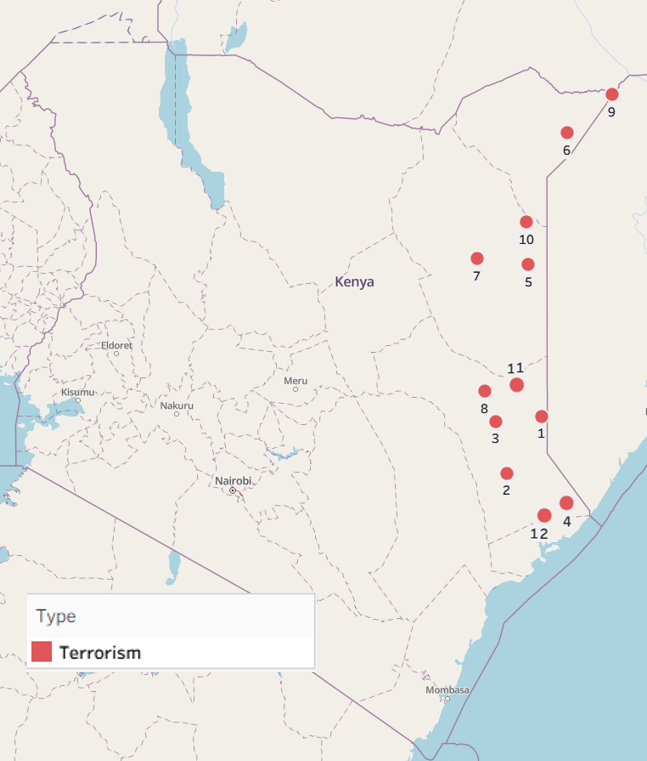
Terrorism: During the past three weeks, a total of 12 terrorist assaults were recorded, with five reported in Garissa, three in Wajir, and two each in Lamu and Mandera counties. The attacks reflect a sustained pattern of militant activity, predominantly attributed to suspected al-Shabaab militants, across Garissa, Wajir, Mandera, and Lamu counties. The incidents varied in nature, including small-arms assaults on military and security installations, improvised explosive device (IED) detonations, targeted ambushes on police officers, and vehicle hijackings. Most attacks targeted Kenya Defence Forces (KDF) bases, Quick Reaction Unit (QRU) camps, or isolated security personnel. - Although there has been a general reduction in fatalities compared to 2024, al-Shabaab and other terrorist groups continue to exploit anniversaries of previous high-profile attacks in Kenya, Somalia, and beyond. January, like December, remains a high-risk month due to significant anniversaries, including the DusitD2 Complex attack in Nairobi (15 January 2019), the El Adde attack on a KDF camp in Somalia (15 January 2016), the Latema Road IED explosion in Nairobi’s CBD (26 January 2019), and the Kulbiyow military base attack in Somalia (27 January 2017). Looking ahead, the threat environment is likely to remain elevated during the first quarter of 2026, particularly in north-eastern counties and Lamu, with militants likely to continue employing small arms and IEDs. Additionally, the risk of complex, multi-modal attacks, including grenades, vehicle-borne IEDs (VBIEDs), small-arms fire, and IEDs, remains credible in major urban centres, notably Nairobi and Mombasa.
Crime: During the reporting period, there has been an increase in criminal activity as well as road traffic accidents across the country. Compared with November, the total number of crimes and civil unrest incidents reported in December rose by 4%. - Overall, the security environment remains complex and multifaceted. Criminal killings, armed robberies, and intercommunal violence have surged in recent months, while politically motivated unrest is likely to escalate in tandem with by-election activities. Combined with the historical patterns of attacks by organised criminal gangs and the potential for opportunistic exploitation of unrest, the threat landscape requires continued monitoring.
Socio-economic: At around 0330hrs on Friday 02 January, a 16-storey building under construction collapsed in the Shopping Centre area of Nairobi’s South C estate, killing two security guards stationed at the site. Lands Cabinet Secretary Alice Wahome attributed the accident to the Nairobi County Government, which had approved four additional floors beyond the 12-storey structure originally sanctioned by the National Construction Authority (NCA) and other oversight agencies. - The collapse demonstrates significant failures in regulatory oversight and adherence to approved construction plans, amid allegations of corruption. It also exposed significant weaknesses in construction supervision, raising broader safety concerns in Nairobi, where the construction of high-end multi-storey buildings continues to surge.
|
Castor Vali maintains its advice to clients to avoid all non-essential travel to counties bordering Somalia – including Mandera, Wajir, Garissa, and Lamu - due to the risk of terrorist attacks. If travel to these areas is essential, clients should consider using police escorts and consult with local authorities ahead of traveling. Travel by air would mitigate the risk of attacks on main roads, although more measures will need to be implemented, considering an existing security alert issued by the National Police Service (NPS) that al-Shabaab has the intent and capability to target aircraft. Organisations with operations in these areas are advised to carefully review their security procedures to protect employees, particularly non-local Kenyans and foreigners. The risk of kidnapping also remains elevated in all areas within 60 km of the Kenya-Somalia border. |
* Significant incidents include terrorism incidents, security operations, and other incidents involving a fatality. |
- Garissa: On Thursday 18 December, suspected al-Shabaab militants launched a small-arms attack on a camp in Amuma town, Fafi Sub-County. Al-Shabaab claimed to have killed an unspecified number of officers.
- Garissa: On Thursday 18 December, suspected al-Shabaab militants detonated an IED targeting a security vehicle near the Galmagala area of Fafi Sub-County. Casualty figures remain unconfirmed.
- Garissa: At around 1600hrs on Wednesday 24 December, suspected al-Shabaab militants carried out a small-arms attack on a KDF military base in the Amuume area, near Fafi District. Reports indicate that four soldiers were killed and four others sustained injuries.
- Lamu: At approximately 1900hrs on Wednesday 24 December, suspected al-Shabaab militants reportedly attacked a KDF military convoy between the Maangaay and Ijaara areas. No casualties were reported.
- Wajir: At around 0900hrs on Sunday 29 December, two police reservists were reportedly kidnapped by armed men suspected to be al-Shabaab militants in Wajir Bor Ward, near the Kenya–Somalia border. The victims were herding livestock at the time of the ambush.
- Mandera: At approximately 1845hrs on Tuesday 30 December, suspected al-Shabaab militants launched a probing attack on the Fino Special Operations Group (SOG) camp in Lafey Sub-County. The attackers fired a rocket-propelled grenade (RPG), but officers successfully repelled the assault. No casualties were reported.
- Wajir: At around 1200hrs on Thursday 01 January, a police officer sustained gunshot injuries after being attacked by six armed men suspected to be al-Shabaab militants at Diff Shopping Centre. The assailants, travelling in a numberless Probox vehicle, ambushed the officer as he sat in his vehicle, with four attackers alighting and opening fire. The attackers subsequently stole the police vehicle and fled towards the Somalia border.
- Garissa: At approximately 0015hrs on Thursday 01 January, security forces reportedly repulsed an al-Shabaab attack on a Quick Reaction Unit (QRU) camp in Saretho after militants targeted the facility with AK-47 rifles. No casualties were reported.
- Mandera: At around 2000hrs on Friday 02 January, suspected al-Shabaab militants hijacked a vehicle belonging to the Kenya National Highways Authority (KeNHA) near Kamor Health Centre in Mandera East Sub-County. The armed assailants ambushed the vehicle and fled with it towards the Somalia border via the Bula Hawa area.
- Wajir: At approximately 2010hrs on Friday 02 January, police reportedly repulsed an attack by suspected al-Shabaab militants armed with RPGs and AK-47 rifles on a QRU camp in Khorof Harar. No casualties were reported.
- Garissa: At approximately 0015hrs on Sunday 04 January, suspected al-Shabaab militants armed with general-purpose machine guns (PKM) and AK-47 rifles reportedly attacked a Border Police Unit (BPU) camp in Yumbis. No casualties were reported.
- Lamu: At approximately 0030hrs on Tuesday 06 January, suspected al-Shabaab militants attacked and destroyed a communications mast in Mangai village. No casualties were reported.
|
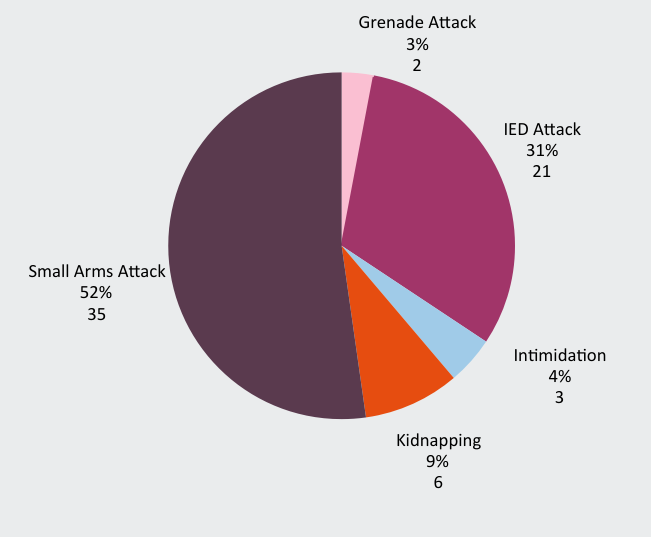
Terrorism statistics by attack mode - the last 12 months |
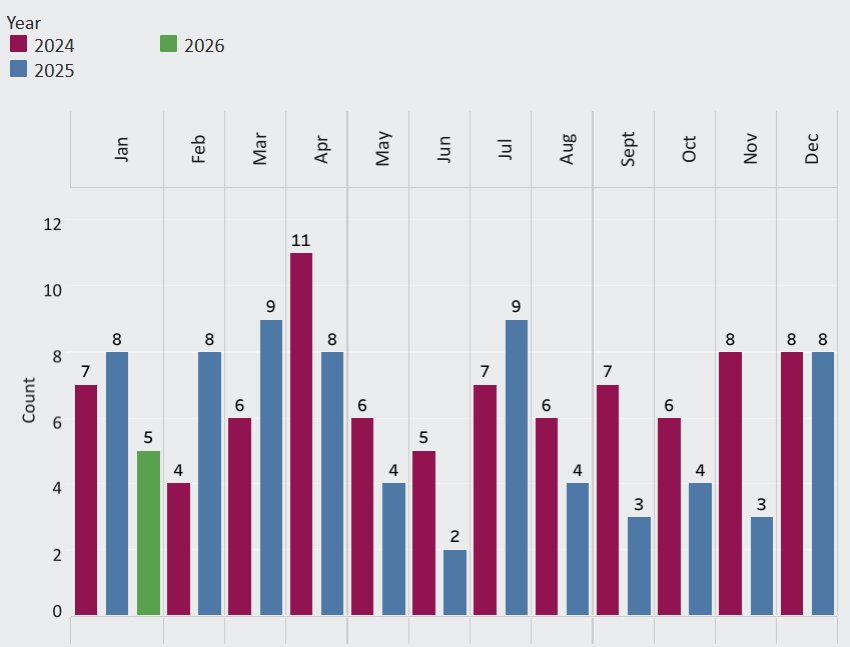
Terrorism incidents by month: 2024 to date |
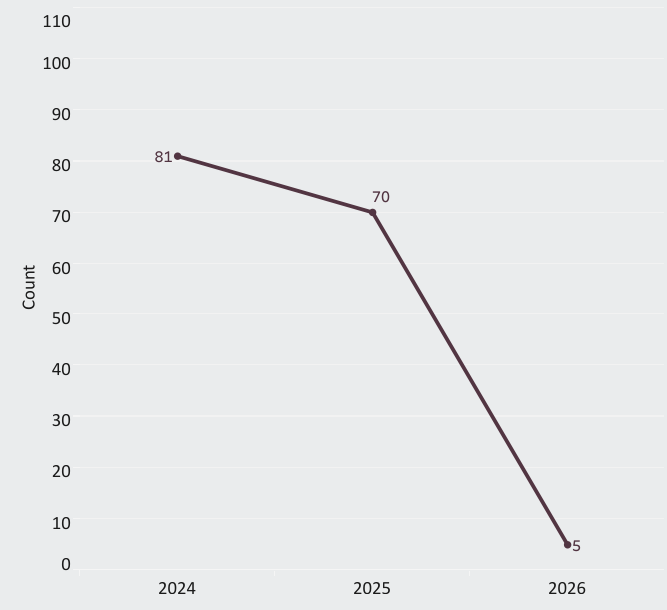
The cumulative terrorism attack trend: January 2024 to date |
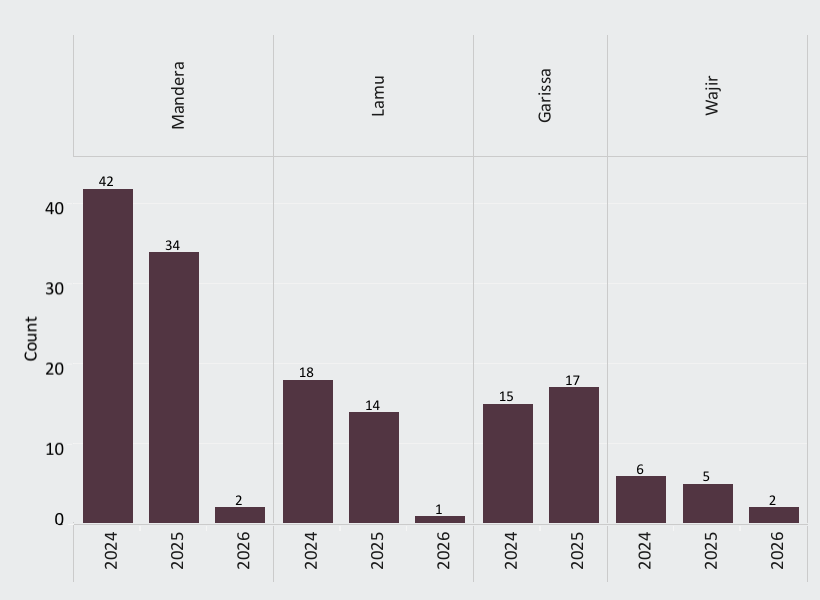
Terrorism statistics by county: January 2024 to date |
Note: Incident reported in Kilifi was bomb scare not an attack. |
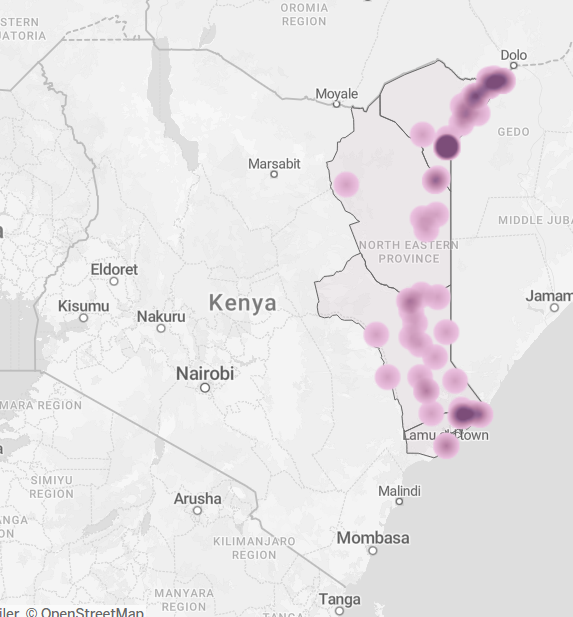
Terrorism heat map - the last 12 months |
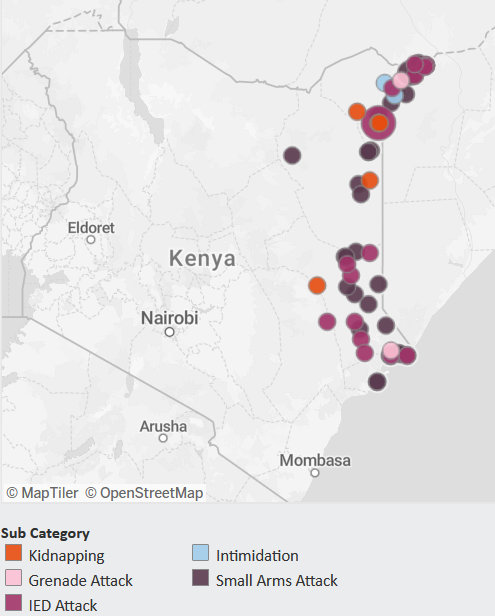
Terrorism incident map - the last 12 months |
Data Sources for all the visuals: CVA and ACLED |
During the past three weeks, a total of 12 terrorist assaults were recorded, with five reported in Garissa, three in Wajir, and two each in Lamu and Mandera counties. The attacks reflect a sustained pattern of militant activity, predominantly attributed to suspected al-Shabaab militants, across Garissa, Wajir, Mandera, and Lamu counties. The incidents varied in nature, including small-arms assaults on military and security installations, IED detonations, targeted ambushes on police officers, and vehicle hijackings. Most attacks targeted KDF bases, QRU camps, or isolated security personnel, indicating a deliberate strategy to undermine state security structures and create instability in border areas. Garissa, in particular, experienced repeated assaults, demonstrating its continued vulnerability to cross-border incursions from Somalia.
Despite the frequency and diversity of the attacks, casualties were relatively limited, with several incidents repelled by security forces and no reported fatalities in some areas, including Lamu and Mandera. Operational patterns indicate that militants intentionally target security personnel while they are most vulnerable, often in remote locations or during routine activities such as livestock herding. Border regions remain the highest-risk zones, and infrastructure assets, including communication masts, have also been targeted.
The reporting period was marked by a surge in militant activity along the Kenya–Somalia border, with December assessed as a high-risk month: indeed, eight attacks were reported in December compared to three in November. The wave of attacks that began in the second week of December persisted into the new year, with five incidents reported during the first week of January 2026. Security personnel, both police and military, including police reservists, remained the primary targets, with small-arms fire being the dominant modus operandi.
Overall, in 2025, Kenya recorded a total of 68 direct attacks and three intimidation incidents, resulting in 60 fatalities, including 11 civilians, seven militants, and 42 security personnel. This represents a decline from 2024, which recorded 93 fatalities, comprising 25 civilians, 48 militants, and 20 security personnel. Mandera remained the primary hotspot, with 34 incidents reported in 2025, down from 41 in 2024. Outside Mandera, militant activity remained significant in Lamu and Garissa, with Garissa recording an increase from 15 incidents in 2024 to 17 in 2025, while Lamu’s incidents declined from 18 to 14. Wajir experienced a slight decrease, from six incidents in 2024 to five in 2025.
Although there has been a general reduction in fatalities compared to 2024, al-Shabaab and other terrorist groups continue to exploit anniversaries of previous high-profile attacks in Kenya, Somalia, and beyond. January, like December, remains a high-risk month due to significant anniversaries, including the DusitD2 Complex attack in Nairobi (15 January 2019), the El Adde attack on a KDF camp in Somalia (15 January 2016), the Latema Road IED explosion in Nairobi’s CBD (26 January 2019), and the Kulbiyow military base attack in Somalia (27 January 2017).
Looking ahead, the threat environment is likely to remain elevated during the first quarter of 2026, particularly in north-eastern counties and Lamu, with militants likely to continue employing small arms and IEDs. Additionally, the risk of complex, multi-modal attacks, including grenades, vehicle-borne IEDs (VBIEDs), small-arms fire, and IEDs, remains credible in major urban centres, notably Nairobi and Mombasa.
|
Crime and Intercommunal Violence |
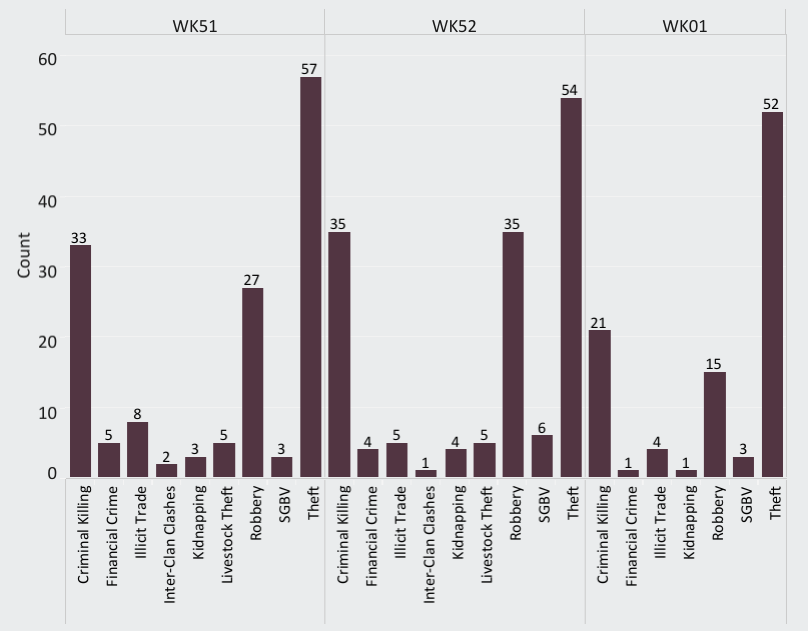
Crime and intercommunal violence events during the review period |
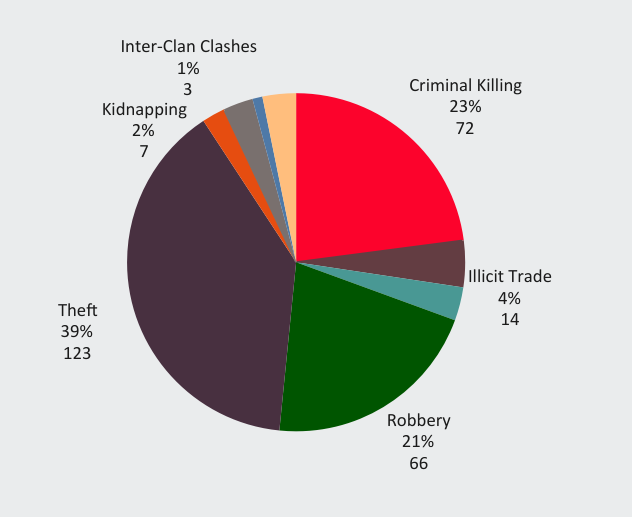
Crime statistics over the past three-week period |
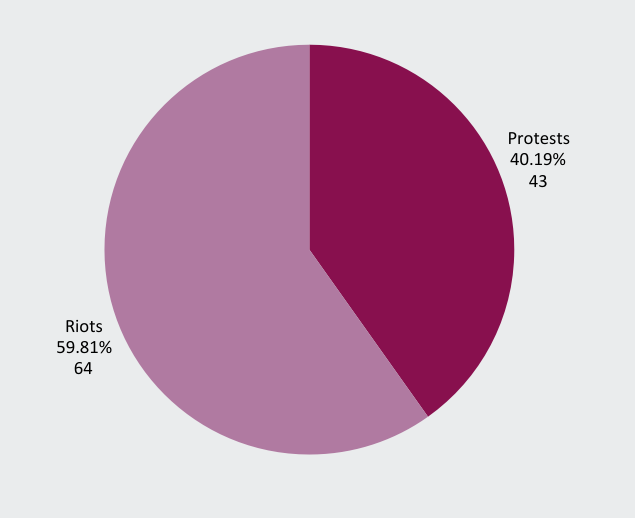
Civil unrest statistics during the review period |
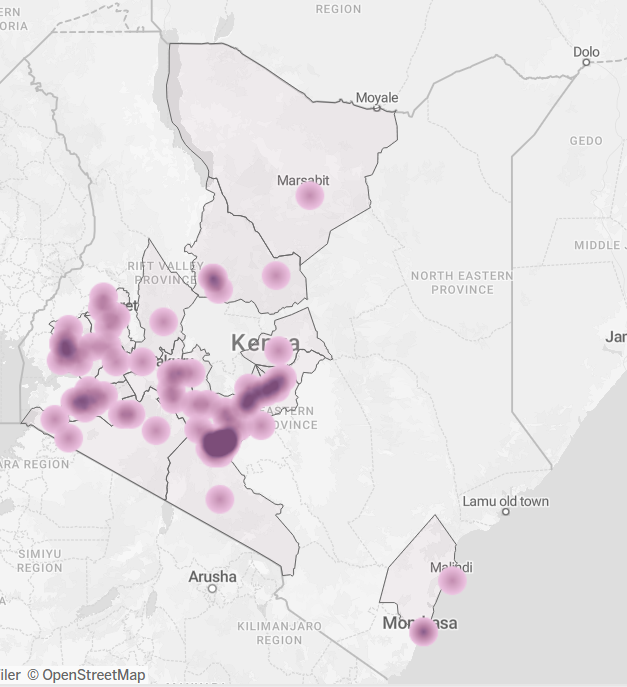
Crime and intercommunal violence - Jan 2026 to Date |
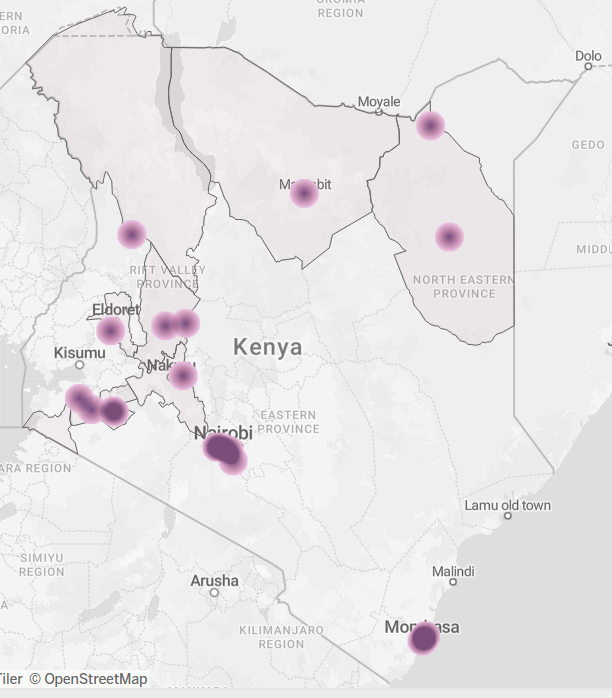
Civil disorder and political unrest - Jan 2026 to date |
Data sources for all the visuals: CVA and ACLED |
Key trends observed during the review period included: - Decline in civil disorder: A notable reduction in civil unrest incidents was recorded over the last three weeks. This decline is largely attributed to the festive season, during which most organisations—including trade unions and human rights groups—scaled down activities.
- Sustained high levels of criminal killings: Despite the overall stability in incident numbers, criminal killings remained persistently high during the review period. Most cases were linked to fatal domestic disputes and incidents of mob justice targeting suspected offenders. The majority of these incidents were reported in Nairobi, Nakuru, Kiambu, Kakamega, Kisii, and Bungoma counties.
- High incidence of robberies and thefts: Robbery and theft accounted for the majority of criminal activity reported during the festive period. Business premises and residential properties remained the primary targets, collectively accounting for more than two-thirds of reported incidents. Gang-related activities were also reported during the period, contributing significantly to elevated crime levels in major urban centres.
- Increase in intercommunal violence and livestock-related theft: Incidents of intercommunal violence and livestock theft continued to pose a significant threat, particularly in Narok and Migori counties, as well as in historically affected areas of the North Rift Valley, eastern, and northern Kenya. In response to the persistence of these threats, 30-day curfews were imposed in parts of Narok and Marsabit counties as security agencies intensified operations to restore stability following a sustained wave of clan clashes in Mara West and Trans Mara South in Narok County. In Marsabit, the curfew represented a further extension, following earlier security designations in September 2024, October 2024, and May 2025, reflecting the protracted nature of intercommunal tensions and criminal activity in northern Kenya.
|
National – General crime and intercommunal violence status update |
This report provides an update on the security advisory issued by the Ministry of Interior on Wednesday 17 December. The advisory highlighted potential risks during the festive season, noting increased threats relating to crime, intercommunal violence, and traffic-related offences.
Assessment
During the reporting period, there has indeed been an increase in criminal activity as well as road traffic accidents across the country. Compared with November, the total number of crimes and civil unrest incidents reported in December rose by 4%. Several notable trends emerged, particularly during the last two weeks of the year: - Decline in civil unrest: Incidents of civil unrest fell by 22% compared with November, with unrest reported in 41 counties, slightly down from 42. Despite this reduction, civil unrest remained widespread nationally. Notably, on Monday 22 December, an attempted march by human rights activists to the State House in Nairobi was disrupted by police within the CBD using tear gas. The demonstrators were protesting the government’s perceived slow response in addressing cases involving youths killed during the anti–Finance Bill protests in 2024.
- Spike in armed robberies and muggings: A surge in armed robberies and muggings was reported in middle- and lower-income neighbourhoods of Nairobi in the lead-up to Christmas and New Year. Multiple sources indicated that perpetrators targeted vulnerable revellers and pedestrians, particularly at night. Residential properties and business premises accounted for 69% of incidents, as many residents travelled out of urban centres for the December holidays. Vacant homes and commercial premises were particularly susceptible. Notably, around 53% of robberies and 67% of thefts occurred during daylight hours, signalling a shift towards daytime offending.
- Robbery and theft hotspots: The primary hotspot counties for robbery and theft were Nairobi, Kiambu, Nakuru, Kakamega, and Uasin Gishu, which together accounted for 43% of all reported incidents nationwide.
- Gang-related crime: In Mombasa, the threat of gang-related criminal activity remained elevated. On Monday 15 December, police officers in Likoni shot two suspected robbers during a targeted security operation aimed at dismantling criminal hideouts. The operation also led to the recovery of stolen motorcycles, mobile phones, and crude weapons, underscoring ongoing law enforcement efforts to curb organised crime in the county.
- Increase in criminal killings: Criminal killings rose sharply by 48% compared with November. The majority of these incidents occurred in Nairobi, Nakuru, Kiambu, Kakamega, Kisii, and Bungoma counties, which together accounted for 40% of all criminal killings in December. Nearly half (47%) of these fatalities were linked to domestic disputes, primarily arising from family and land-related grievances. Additional cases involved gender-based violence resulting in death, while other killings remain unexplained, with bodies discovered abandoned in isolated locations such as thickets, riverbeds, and roadsides.
- Surge in intercommunal violence: Violent clan clashes and livestock theft incidents were reported in North Rift Valley counties as well as in eastern and northern Kenya. Clashes were also noted in western counties, particularly Migori, Kisii, and Narok. Some of these incidents occurred despite existing countermeasures, including ongoing security operations and imposed curfews.
- Significant rise in fatal road traffic accidents (RTAs): From January to mid-November, 4,195 deaths were reported, rising further to over 4,400 by December, according to some reports. The number is expected to increase further due to additional fatal RTAs reported in December. Official figures from the National Transport and Safety Authority (NTSA) are yet to be released.
Looking ahead Civil unrest in Kenya is expected to rise in the short to medium term, driven by a combination of unresolved grievances and emerging political tensions. Allegations of abductions targeting government critics, alongside ongoing strike actions by trade unions demanding the implementation of Collective Bargaining Agreements (CBAs), are likely to fuel public dissatisfaction. The socio-economic pressures of the festive season and the continuing spike in criminal activities, particularly armed robberies and muggings in urban centres, may also exacerbate tensions, providing opportunities for civil disturbances to escalate.
Politically motivated unrest is anticipated to intensify ahead of the 29 February by-elections and ahead of the 2027 general election, as candidates and political actors increase campaign activities, consolidate alliances, and mobilise supporters. The positions to be contested include the Member of the National Assembly for Isiolo South Constituency, following the death of the incumbent, as well as three County Assembly seats: Muminji Ward and Evurore Ward in Embu County, and West Kabras Ward in Kakamega County. Heightened political activity in these areas could provoke demonstrations, protests, and confrontations, particularly in urban centres and county headquarters. At the regional level, the outcome of Uganda’s presidential election on 15 January could also trigger domestic unrest, either in support of or in opposition to the results.
Criminal elements are likely to exploit periods of unrest to conduct opportunistic crimes. During civil disturbances, acts of lawlessness such as break-ins, muggings, and targeted robberies against commercial outlets, motorists, and civilians are likely to increase. Past trends indicate that criminals actively leverage social disorder to commit theft, and this risk is expected to remain high in Nairobi, Kiambu, Nakuru, and other major urban centres where robbery and theft hotspots have been historically recorded.
Separately, intercommunal and clan-related violence remains a significant concern, particularly in the North Rift Valley and northern Kenya counties. The clan clashes in Narok, triggered by a livestock theft incident on 23 November that resulted in two fatalities, led to a series of retaliatory attacks in December, causing an additional five deaths. In response, the government imposed a dawn-to-dusk curfew and declared parts of Narok County security-disturbed for 30 days, covering Trans Mara West and Trans Mara South. This measure reflects ongoing efforts to contain retaliatory violence and strengthen peace-building initiatives in affected areas.
Northern counties such as Marsabit continue to experience sustained security threats. On 19 December, the Interior Cabinet Secretary extended the “security-disturbed and dangerous” designation for 13 areas in Marsabit for an additional 30 days, following consultations with the National Security Council. This extension reflects the protracted threat of intercommunal clashes and criminal activity in northern Kenya, despite prior designations in September 2024, October 2024, and May 2025. Such recurrent security measures highlight the persistence of underlying instability in the region and the need for targeted interventions.
Overall, the security environment remains complex and multifaceted. Criminal killings, armed robberies, and intercommunal violence have surged in recent months, while politically motivated unrest is likely to escalate in tandem with by-election activities. Combined with the historical patterns of attacks by organised criminal gangs and the potential for opportunistic exploitation of unrest, the threat landscape requires continued monitoring.
|
Socio-economic Development |
Nairobi – Building collapse exposes regulatory failures and unauthorised construction |
At around 0330hrs on Friday 02 January, a 16-storey building under construction collapsed in the Shopping Centre area of Nairobi’s South C estate, killing two security guards stationed at the site. Lands Cabinet Secretary Alice Wahome attributed the collapse to the Nairobi County Government, noting that it had approved four additional floors beyond the 12-storey structure originally sanctioned by the National Construction Authority (NCA) and other oversight agencies.
Meanwhile, an activist has petitioned the High Court seeking the removal of NCA Chief Executive Officer Maurice Aketch, citing regulatory failures that allegedly contributed to the collapse. The activist contends that investigations revealed the building was constructed without approved structural plans, mandatory inspections, or geotechnical assessment reports. The NCA confirmed that at the time of the collapse, the building was non-compliant.
Assessment
The NCA confirmed that the South C building was registered on 08 November 2023 and initially complied with all statutory requirements, including valid National Environment Management Authority (NEMA) licensing, Nairobi City County approvals, and a geotechnical investigation report. The approved structural design permitted a 12-storey building, and four quality assurance inspections were conducted between March and August 2024, all of which were deemed compliant. At the time of the final inspection, construction had reached only the third floor. Subsequent investigations revealed that four additional floors had been added without authorisation, rendering the project non-compliant. Lands Cabinet Secretary Alice Wahome blamed the county for approving these extra floors without consulting other regulatory bodies.
The collapse demonstrates significant failures in regulatory oversight and adherence to approved construction plans, coupled with corruption allegations. While the project initially met all requirements, the unauthorised vertical expansion highlights gaps in enforcement and monitoring. Wahome described the county officials’ actions as rogue and criminal, noting that these deviations directly compromised structural safety.
The incident also exposed weaknesses in construction supervision. Although the NCA conducted multiple inspections, the unapproved floors went undetected until after the collapse, raising concerns about inter-agency coordination and the effectiveness of ongoing oversight. Accountability now extends to all parties involved, including county officials, developers, contractors, and other professionals responsible for the project. This accident raises broader safety concerns in Nairobi, where the construction of high-end multi-storey buildings continues to surge.
|
| Date | Event | Advisory | | Thursday 15 January | The seventh anniversary of Dusit2 Riverside attack in Nairobi. | Heightened risk of terrorism in the hotspot counties | | Thursday 15 January | The tenth anniversary of the El Adde attack on a KDF camp in Somalia | Heightened risk of terrorism in the hotspot counties | | Monday 26 January | The seventh anniversary of the Latema Road IED explosion in Nairobi’s CBD | Heightened risk of terrorism in the hotspot counties | | Tuesday 27 January | Kulbiyow military base attack in Somalia | Heightened risk of terrorism in the hotspot counties |
|
Foreign Government Travel Advice |
UK FCDO
Last update: 10 December 2025 Click here to read the full travel advice. |
US Embassy Kenya
Last update: 19 August 2025 Click here to read the full travel advice. |
Australia DFAT Last update: 05 December 2025 Click here to read the full travel advice. |
Canada DFA Last update: 07 January 2026 Click here to read the full travel advice. |
Disclaimer
You have received this report as part of your organisation’s subscription. Castor Vali assessment and advice is given based on the information received and processed by us and the surrounding circumstances known to us to exist at the time. Subsequent changes to relevant information or the surrounding circumstances may affect the reliability of our assessment and advice, but we do not accept responsibility for that effect. We do not accept responsibility for the outcome of any action taken or not taken as a result of our assessment and advice unless the possibility of that action being taken or not taken is set out in specific terms in our instructions. |
UK Global Head Office: Castor Vali Ltd
Davidson House, Forbury Square, Reading, RG1 3EU, United Kingdom
West Africa Regional Headquarters: Castor Vali Nigeria
No 56a Akintude Adeyemi Drive, Off Chief
Collins Street, Lekki Phase 1, Lagos, Nigeria
East Africa Regional Headquarters: Castor Vali Africa (Kenya)
Unit B, Northern Wing, 2nd Floor, Nairobi Business Park, Ngong Road,
Nairobi, Kenya. PO Box +254 711 105 879 – 00505
United Kingdom | Nigeria | Ghana | Somalia | Kenya | Tanzania | Zanzibar |
Mozambique | South Africa | Mauritius | Dubai
Operations Centre (24 Hrs): +254 (0) 20 440 9614 | +254 (0) 711 105 879
info@castorvali.com |
|